
This speech was delivered as the valedictorian address for the graduating class of 2026, Rosary College’s first graduating class.
What has our liberal education done for us? Is it career preparation? Is it refinement in writing and speaking? These may be present, but career success and personal development are, ultimately, empty goals; if we’ve been working towards them for the past two years, our labor has been in vain.
What has our liberal education done for us?
There’s a different question we need to answer first. What differentiates liberal education from other types of education? Liberal education operates at an existential level. It doesn’t merely cram things into our brains; it changes who we are.
This existential change is a process of healing. Each of our minds is in need of healing; the reason is that we’re all born blind. This blindness is intellectual and spiritual: our minds can’t perceive the world as it really is. True reality, or simply the truth, is a beautiful thing; but because of passions, biases, and sins, we’re unable to see it. Each and every one of us has come into this world blind.
And we often remain blind throughout our lives. Take, for example, the testimony of Boethius, a 6th-century Roman, Christian politician, in The Consolation of Philosophy. Boethius is imprisoned and on the threshold of execution, and he describes himself as “drowned in darkness,” “his mind light-forsaken” (1.met.2). In the midst of despair, he’s become blind.
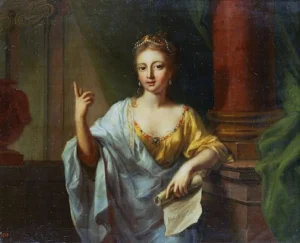
But then comes Lady Philosophy, and this is what she says: “now is the time for remedies” (1.pr.2). The remedy she uses is education; she, an image of learning and understanding, cures Boethius by educating him. By leading him to the truth, she lightens his moral darkness.
Education, then, is tasked with healing us. But this process is difficult.
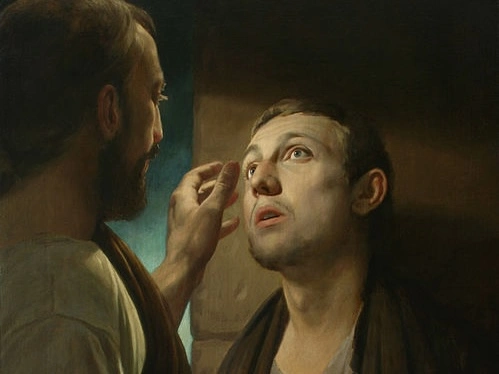
Helpful here is a passage from the gospel of Mark. A blind man is brought to Christ; Christ “spit on his eyes and laid his hands upon him,” then asked, “Do you see anything?” The blind man says, “I see men; but they look like trees, walking.” Then Christ “laid his hands again upon his eyes; and he looked intently and was restored, and saw everything clearly” (Mark 8:23-25).
I mention this passage for two reasons. The first is to emphasize that the curative process of education requires healers, physicians to cure our blindness. And we, indeed, have had many healers, who have opened our eyes to true reality. Fortunately, Dr. Esparza and Professor Pearce didn’t literally spit on my eyes, but, nevertheless, I think this is a valuable image. Our teachers have healed us with immense labor and care, even putting forth a part of themselves; they’ve opened our eyes by their very spit.
But this is not an instantaneous process. The sight of the blind man in the gospel is blurry before it’s clear. We’ve been put on a trajectory to understanding true reality, but it’s not complete; we have the responsibility to continue the healing process throughout our lives.
This is what sets liberal education apart: it enables us to gaze at reality. But why is this gaze so valuable?
Here, we can look to the great canon of Greek philosophy. Both Plato and Aristotle see the highest, most blessed mode of existence as contemplation. Remember the allegory of the cave in Plato’s Republic. The people who are truly happy, says Plato, have ascended from the realm of illusory shadows and gazed into the blinding, beautiful light of the day; they experience “divine contemplation” (517d).
Contemplation is precisely the gaze at true reality that liberal education fosters in us. Plato, after all, says that his allegory is “an image of our nature in its education and want of education” (514a). Plato’s ideal of contemplation is integrally linked to the process of education.
But the gaze of contemplation is not mere perception; when we contemplate something, our being comes into contact with that thing. The purpose of contemplation is communion. When we contemplate things, we’re moved to union with them.
At the end of these two years, I can attest from experience that our education has fostered contemplation in us. We did not merely memorize things; we entered them and contemplated them. Through the art of Botticelli, through music of Palestrina, through the verse of Dante, we contemplated. In the beauty of nature, the mystery of Christology, even the measured order of geometry and Latin, we contemplated.
All this time, we’ve been gazing at true reality. But true reality is more than merely the world. It’s God. We have been looking at God; we’ve caught glimpses of him throughout our process of healing. Like Moses on Mount Sinai, we’ve seen his backside. That’s why liberal education is so important: it leads us to contemplate God. And when we truly contemplate God, we will become united to him. True education is sanctifying.
What, finally, has our liberal education done for us?
We’ve seen God. That’s all.